
AI-powered Agile Insights
AI-powered Agile Insights
The insights agile leaders craved were already there, scattered across team canvases. I designed the experience that brought all of those insights together.
Senior UX Designer | Fall 2024–Spring 2025 | Lucid Software
Senior UX Designer
Fall 2024–Spring 2025
Lucid Software
Overview
Overview
Problem
Enterprise leaders had no scalable way to aggregate qualitative team data (risks, blockers, sentiment) without disrupting team workflows.
Solution
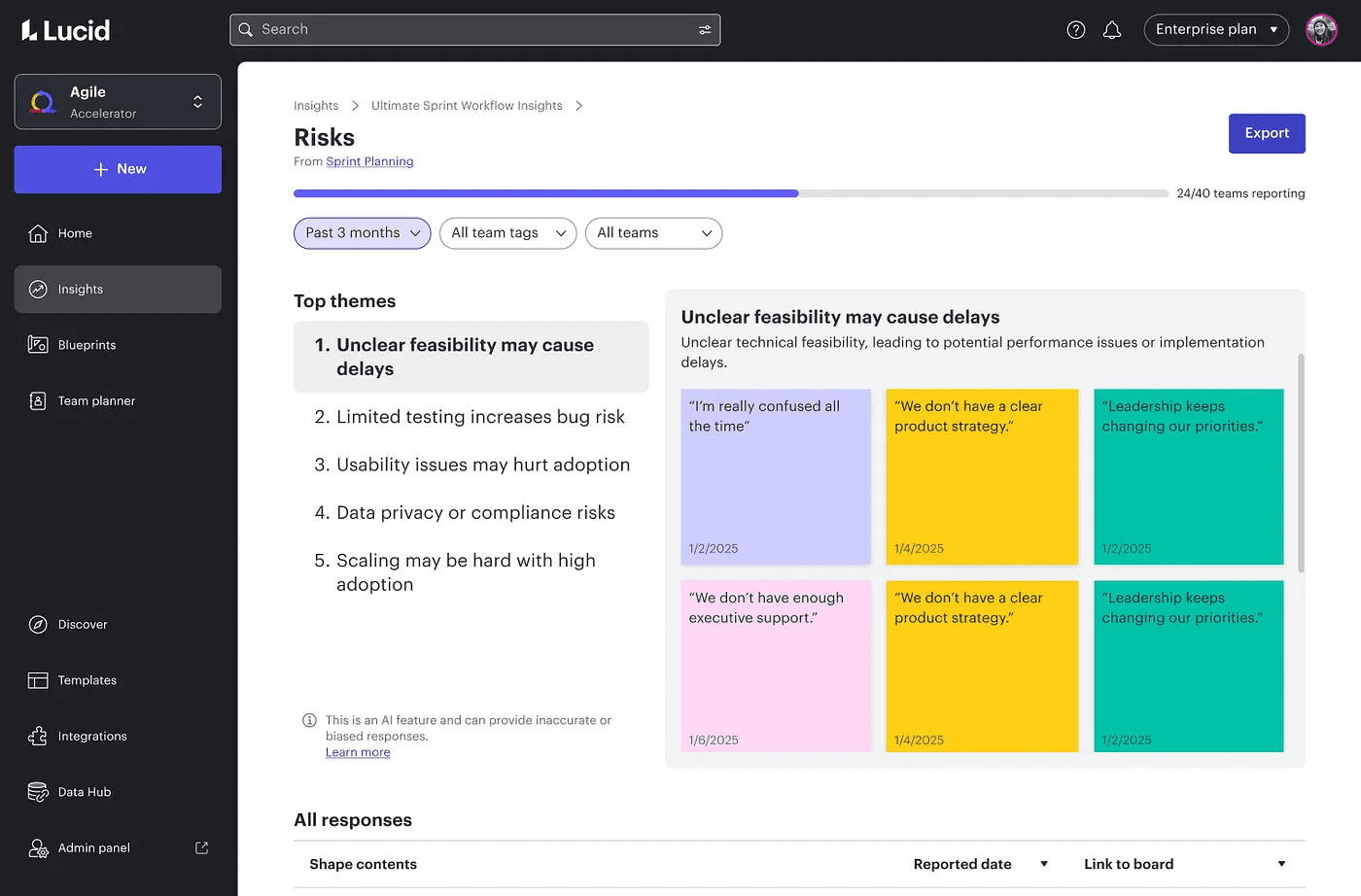
An AI-powered insights dashboard that surfaces qualitative context from working documents, anonymized to protect psychological safety.
Impact
Shipped to multiple enterprise accounts.
Lucid's VP of UX touted it as "maybe the best use of AI we've had so far in terms of utility."
Problem
Enterprise leaders had no scalable way to aggregate qualitative team data (risks, blockers, sentiment) without disrupting team workflows.
Solution
An AI-powered insights dashboard that surfaces qualitative context from working documents, anonymized to protect psychological safety.
Impact
Shipped to multiple enterprise accounts.
Lucid's VP of UX touted it as "maybe the best use of AI we've had so far in terms of utility."
Executives were flying blind on the stuff that actually mattered
Executives were flying blind on the stuff that actually mattered
Large organizations practicing Agile had plenty of quantitative dashboards. What they couldn't easily see was the qualitative picture: why teams were behind, what was blocking progress, how people were feeling. Getting that context meant cascading questions down through layers of management, a slow and disruptive process.
Large organizations practicing Agile had plenty of quantitative dashboards. What they couldn't easily see was the qualitative picture: why teams were behind, what was blocking progress, how people were feeling. Getting that context meant cascading questions down through layers of management, a slow and disruptive process.
Research revealed two personas with the same blind spot
Research revealed two personas with the same blind spot
Through user interviews, I identified two distinct users: middle managers who needed to surface information upward, and executive leaders who needed to understand the "why" behind delays quickly. Both had dashboards. Neither had an easy way to aggregate qualitative context. That gap became the design target.
Through user interviews, I identified two distinct users: middle managers who needed to surface information upward, and executive leaders who needed to understand the "why" behind delays quickly. Both had dashboards. Neither had an easy way to aggregate qualitative context. That gap became the design target.
AI summarization filled the qualitative gap leaders didn't know they had
AI summarization filled the qualitative gap leaders didn't know they had
Rather than building another quantitative dashboard, I designed an AI-powered insights view that aggregates risks, blockers, and team sentiment directly from working documents. All team data is anonymized to protect psychological safety. Leaders get direct visibility without ever interrupting a team.
Rather than building another quantitative dashboard, I designed an AI-powered insights view that aggregates risks, blockers, and team sentiment directly from working documents. All team data is anonymized to protect psychological safety. Leaders get direct visibility without ever interrupting a team.

Iteration zeroed in on what users actually cared about
Iteration zeroed in on what users actually cared about
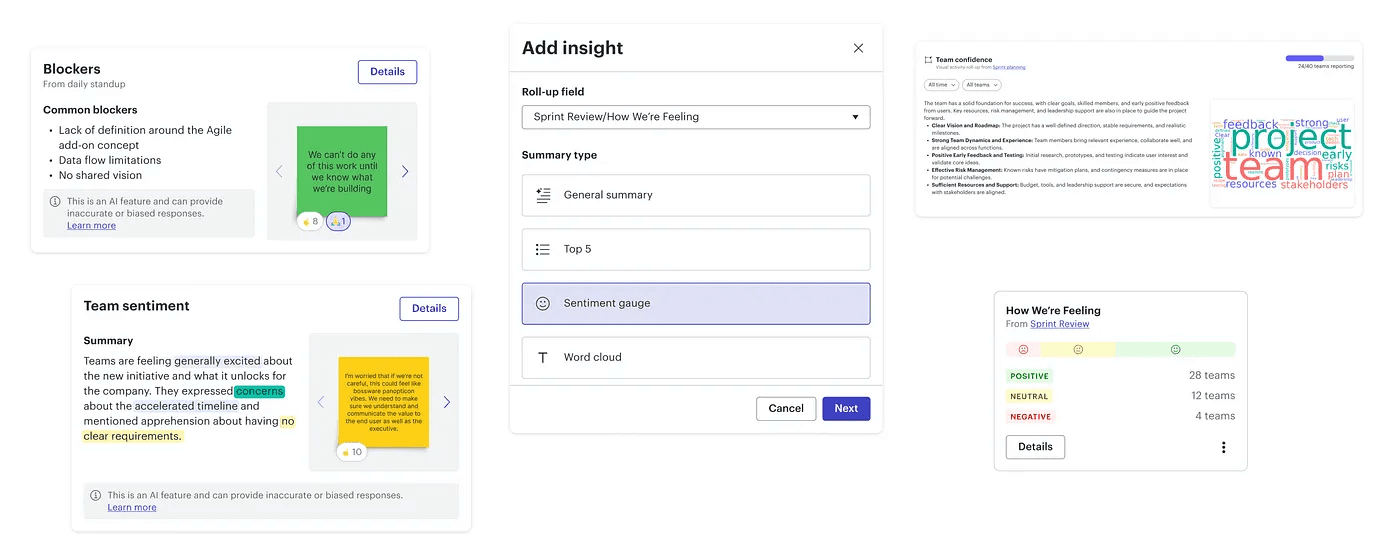
I explored multiple approaches for presenting AI-summarized content: sticky note imagery, sentiment gauges, word clouds. User feedback was clear: what mattered most was risks and blockers. I anchored the design around those, and added the ability to drill into full context for leaders who needed more than the summary.
I explored multiple approaches for presenting AI-summarized content: sticky note imagery, sentiment gauges, word clouds. User feedback was clear: what mattered most was risks and blockers. I anchored the design around those, and added the ability to drill into full context for leaders who needed more than the summary.
Shipped to enterprise, validated by customers and leadership
Shipped to enterprise, validated by customers and leadership
The feature shipped in Spring 2025 and landed with multiple enterprise accounts on trials and full licenses. Internal reaction was strong, and customer feedback confirmed the core value: teams said it would save significant manual effort and described it as genuinely useful in large distributed organizations.
The feature shipped in Spring 2025 and landed with multiple enterprise accounts on trials and full licenses. Internal reaction was strong, and customer feedback confirmed the core value: teams said it would save significant manual effort and described it as genuinely useful in large distributed organizations.
Designing AI products means negotiating between the model and the user
Designing AI products means negotiating between the model and the user
The biggest lesson from this project was the tension between development constraints like minimizing token usage and user experience goals. Finding the right balance between automated insights and human context wasn't a UX problem or an engineering problem. It was both, and solving it required staying closely connected to both sides.
The biggest lesson from this project was the tension between development constraints like minimizing token usage and user experience goals. Finding the right balance between automated insights and human context wasn't a UX problem or an engineering problem. It was both, and solving it required staying closely connected to both sides.